What is a Commercial Food Waste Composting Machine?
A commercial food waste composting machine is an on-site organic waste composter machine that quickly turns food scraps into nutrient rich compost. It processes commercial food waste like vegetable peels, leftovers, and garden trimmings. Businesses use it for efficient commercial organic waste disposal and management.
A commercial organic waste machine processes large volumes of organic waste into compost in 24 hours. It handles commercial food waste from kitchens and canteens. Businesses use it for sustainable waste management solutions.
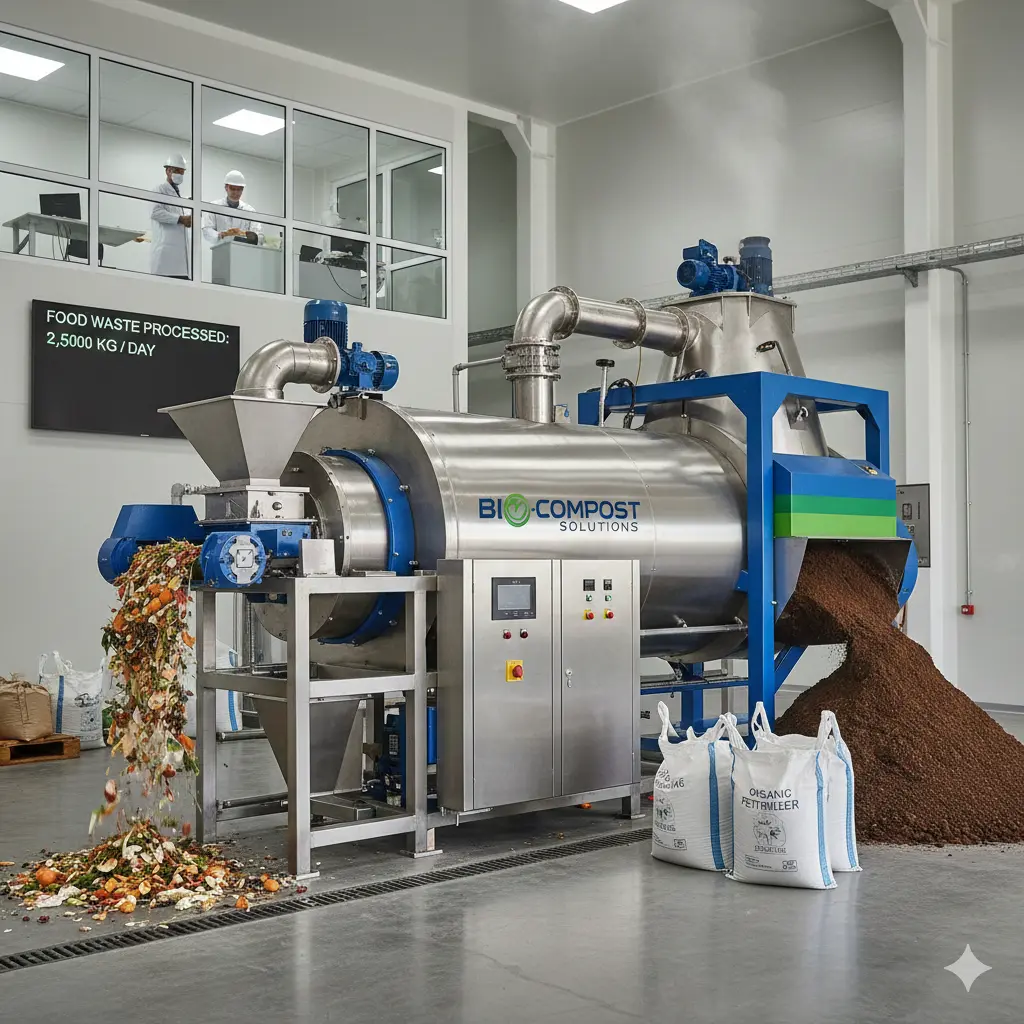
Key components of a typical OWC / organic waste composter machine
-
Shredder: Breaks down tough items like bones and peels.
-
Mixing shaft: Ensures even aeration and microbial action.
-
Heater and sensors: Control temperature and humidity for optimal organic waste composting machine process.
-
Exhaust blower: Removes moisture and odors safely.
-
PLC control panel: Automates the entire cycle.
Why Businesses Need Commercial Organic Waste Machines
-
Cuts disposal costs by 80-90% through volume reduction.
-
Produces sellable compost, creating revenue streams.
-
Meets rising demand for green practices in hotels and factories.
-
Supports franchise opportunities in waste management solutions.
What Are the Challenges of Waste Management in Cities?
-
Rapid population growth increases daily waste generation.
-
Poor waste segregation at source (wet and dry waste mixed).
-
Limited space for landfills in urban areas.
-
Overflowing dumping sites causing pollution.
-
High cost of waste collection and transportation.
-
Lack of public awareness about proper disposal.
-
Plastic waste mixing with organic waste.
-
Weak enforcement of waste management rules.
-
Shortage of modern waste processing facilities.
-
Air, water, and soil pollution from untreated waste.
-
Methane gas emissions from landfills contributing to climate change.
-
Irregular waste collection in some areas.
Compliance with SWM Rules 2016 and Local Regulations
|
Requirement |
SWM Rules 2016 Details |
Business Impact |
|
Segregation at source |
Mandatory for all generators |
Fines up to ₹1 lakh for non-compliance |
|
Bulk generators (>100 kg/day) |
On-site processing required |
Install commercial organic waste machine or tie-up |
|
Compost usage |
Promote bio-stabilization |
Use output for landscaping to avoid landfill fees |
|
Reporting |
Annual returns to local body |
Track via machine logs for audits |
What Role Do ESG, CSR, and Green Campus Goals Play for Institutions and Corporates?
ESG reporting now demands waste reduction metrics. Corporates use commercial organic food waste composting machines for CSR projects. Institutions achieve green campus certification with zero waste systems. These align with national sustainability drives.To reduce landfill waste and improve urban cleanliness, many cities are adopting advanced organic waste composting systems like the ones offered by Pious Earth.
How a Commercial Organic Waste Machine Works
These machines speed up nature's composting with tech and microbes. Input waste gets shredded, heated, and aerated. Output is dry compost ready for use.
These are Followings steps for Commercial Organic Waste Machine Work.
-
Shredder crushes it; microbes and water activate breakdown.
-
The heater raises temp to 55°C; mixer aerates for 24 hours.
-
Blower vents vapor; volume shrinks 80%.
-
Collect granular compost for gardens or sale.
How is it different from household composters?
-
Bigger setup: for 25-1000 kg each day vis a vis 5-10 kg for home applications.
-
Faster conditioning: with this system from Excel, compost is ready within 24 hours and not in a process of weeks.
-
Totally automatic: No manual turning, like in the lowest end of the system.
-
Odor-free: Filters built within kitchens provide essential protection from nasty neighboring odors.
Types of Commercial Organic Waste Machines
Choose based on volume and space. Automatic organic waste composting machines dominate for ease. Explore options from top organic waste composting machine manufacturers.
-
Fully automatic: 24 hour cycle, ideal for hotels
-
Semi-automatic: Lower cost, manual steps for factories.
-
In-vessel: Sealed for hygiene, like stainless steel bio digester.
-
Drum rotary: For Industrial Food Waste Management Systems
-
Large-scale: Composting Machine for Housing Societies
Key Features to Look For in a Commercial Food Waste Composting Machine
-
Capacity matching daily waste: 50-500 kg for most businesses.
-
Stainless steel construction for durability.
-
Auto shut-off and safety sensors.
-
Low power use: 1-2 kW daily.
-
Odor control with bio-filters.
Benefits of Using a Commercial Organic Waste Machine
-
Reduces landfill waste by 90%, cutting methane.
-
Generates nutrient-rich compost for on-site use.
-
Lowers hauling costs and labor needs.
-
Boosts ESG scores for corporations.
-
Handles what counts as organic waste effortlessly, from canteen waste to garden trimmings.
-
Enables efficient canteen waste management for factories and hospital waste composting equipment.
How to Choose the Right Commercial Organic Waste Machine
-
Assess daily waste: Match kg capacity.
-
Check space: Compact for indoors.
-
Verify certifications: CPCB approved.
-
Review after-sales: Training and service.
-
Compare from organic waste composting machine manufacturer like
Installation, Operation and Maintenance
|
Aspect |
Details |
Tips |
|
Installation |
1-2 days by vendor; needs 3-phase power |
Ensure ventilation; level floor |
|
Operation |
Load waste, press start; 24-hr cycle |
Add only organic; no plastics |
|
Maintenance |
Weekly clean; annual service |
Check shredder blades; ₹5k/year cost |
Conclusion: Moving Towards Zero-Waste with Commercial Organic Waste Machines
Adopt a commercial organic waste converter machine today for SWM Rules 2016 compliance and major hauling cost savings. It turns commercial food waste disposer challenges into profit through compost sales and decentralized waste management systems. Businesses cut landfill waste by 85-90% while boosting ESG scores. Hotels, factories, and campuses eliminate odors and pests to lead sustainability.
Frequently Asked Questions for Commercial Organic Waste Machines
Q: What comes under organic waste?
Food scraps, peels, garden waste, and leftovers. Avoid plastics or metals.
Q: What is the organic waste composting machine process?
Shred, heat, aerate for 24 hours to get compost. Simple one-touch operation.
Q: Can commercial organic waste machines handle canteen waste from factories?
Yes, these machines efficiently process high-volume canteen waste from factories, turning food scraps into compost within 24-48 hours while eliminating odors and meeting SWM Rules 2016 requirements.
Q: What counts as organic waste for commercial food waste machines?
Kitchen waste, veggie trims, and canteen waste. Up to 80% volume reduction.
Q: Are commercial organic waste composter machines CPCB approved?
Yes, most models comply with SWM Rules 2016 for bulk generators.
