Compost Quality Standards in India: FCO Guidelines, Testing Parameters & Certification Process
India faces massive food wastage challenges, with total waste generated in India per year reaching over 62 million tonnes from urban areas alone. Government of India food waste composting plays a key role in tackling this through compost quality standards India enforces. These standards ensure safe, nutrient-rich compost from food waste management in India efforts.
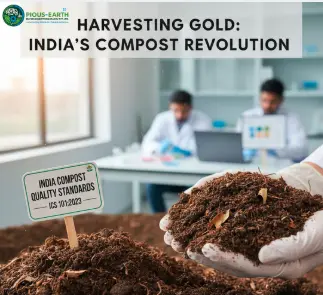
What Are Compost Quality Standards in India?
The Indian compost guidelines are legal regulations based on the Fertilizer Control Order (FCO) 1985, which ensure quality and safety in compost. The regulations require testing for nutrient content and heavy metals and pathogens that can affect agricultural use. This keeps soil and crops healthy amid rising india food wastage issues.
Why Compost Quality Standards Are Important for Farmers and Organic Growers
-
Protect crops against harmful pollutants such as heavy metals from compost.
-
Advanced systems like PLC Controlled Food Waste Converter help produce consistent and contamination-free compost.
-
Facilitates soil enhancing organic farming, leading to higher yields.
-
Supports government schemes for food waste composting in India by ensuring reliable products.
-
Helps farmers access food waste to compost subsidy in India programs.
-
Aligns with Swachh Bharat food waste management goals for sustainable practices.
How Compost Quality Impacts Soil Health and Crop Yield
|
Parameter |
Positive Impact on Soil Health |
Effect on Crop Yield |
|
Nutrient Balance |
Improves organic matter and microbial activity |
Increases by 20-30% |
|
pH Stability |
Maintains neutral soil pH for root growth |
Boosts uptake by 15% |
|
Pathogen Control |
Reduces disease risk in soil |
Reduces losses by 10-25% |
|
Heavy Metal Limit |
Prevents toxicity buildup |
Sustains long-term yields |
Quality compost enhances soil structure while poor ones harm it. Farmers see direct gains in productivity. Data shows compliant compost lifts yields notably.
FCO Standards for Compost in India (Fertilizer Control Order 1985)
-
There shall exist a minimum level of NPK in the content-Nitrogen: 0.4%, Phosphorus: 0.4%, Potassium: 0.4%
-
It also requires the quantities of lead to be kept less than 200 mg/kg and cadmium to less than 5 mg/kg.
-
The laws decree that the presence of pathogens must always be below 1000 CFU/g.
-
Covers city compost from municipal solid waste composting India.
-
Updated via notifications for organic waste composting guidelines by the Indian government.
The FCO ensures compost fits India food waste composting policy frameworks. It promotes safe use nationwide. Compliance is checked rigorously.
Compost Quality Parameters and Testing Requirements
-
Nutrients: Minimum organic carbon 12-20%, NPK as per grade.
-
Physical: Moisture under 50%, particle size 0.25-4 cm.
-
Chemical: pH 6-8.5, electrical conductivity below 4 dS/m.
-
Biological: No salmonella, fecal coliforms under 1000 MPN/g.
-
Toxins: Arsenic max 10 mg/kg, mercury 0.15 mg/kg.
Testing follows Bureau of Indian Standards (BIS) methods. Labs verify each batch. This upholds compost quality standards India wide.
What Are the Key Compost Testing Parameters in India?
-
Parameters include nutrients, pH, and contaminants. Each has strict limits under FCO. Regular checks prevent farm risks.
Moisture Content – Checks whether the compost has the right amount of water for healthy soil application. -
pH Level – Ensures the compost is neither too acidic nor too alkaline; ideal range is 6.5 to 7.5.
-
Electrical Conductivity (EC) – Measures salt levels to avoid soil damage.
-
Organic Carbon – Shows the amount of decomposed organic matter in the compost.
-
Carbon to Nitrogen Ratio (C:N Ratio) – Indicates compost maturity; the ideal range is 15:1 to 20:1.
-
Nitrogen, Phosphorus, and Potassium (NPK) – Essential nutrients that improve soil fertility and plant growth.
-
Heavy Metal Levels – Ensures safe limits of metals like lead, cadmium, and chromium.
-
Pathogen Check – Confirms the compost is free from harmful bacteria such as Salmonella and E. coli.
-
Compost Stability and Maturity – Ensures the compost is fully decomposed and safe for crops.
-
Physical Impurities – Checks for unwanted materials like plastic, glass, or stones.
Compost Testing Labs and Certification Process in India
|
Step |
Description |
Key Labs/Body |
|
Sample Collection |
Random sampling from batches |
NABL-accredited labs |
|
Lab Analysis |
Tests for 15+ parameters |
SGS, ITC Labs |
|
Certification |
BIS/FCO approval post-pass |
Central Fertilizer Quality Control |
|
Validity |
1 year with batch marking |
State agri depts |
|
Renewal |
Re-testing for new lots |
Online portal submission |
Labs like those under the Ministry of Environment food waste management India handle volumes. Certification takes 15-30 days. Farmers rely on this for trust.
Compost Packaging and Labeling Rules in India
-
Bags must be 25-50 kg, tamper-proof with batch numbers.
-
Labels show FCO grade, nutrient content, manufacturer details.
-
Warnings for safe use and expiry date mandatory.
-
Eco-friendly packaging encouraged under India composting initiatives.
-
Claims like "organic" need certification backing.
Clear labeling aids food waste recycling rules in India 2026 compliance. It informs users fully. Violations attract fines.
Latest Government Guidelines on Compost Promotion in India
-
Paramparagat Krishi Vikas Yojana (PKVY) offers subsidies for compost units.
-
The National Mission for Sustainable Agriculture pushes decentralized waste management systems.
-
Swachh Bharat Mission integrates urban composting programs India wide.
-
The mission focuses on reducing landfill dumping, as food waste affects the environment through methane emissions and soil contamination.
-
Food waste to compost subsidy in India up to 50% for compost machines by the Indian government.
-
Recent 2026 updates mandate composting in smart city composting India projects.
These align with Indian government organic waste management efforts. They cut india food wastage effectively. States run programs too.
How to get FCO compost certification in India
-
Make sure your compost meets quality standards (moisture, pH, organic carbon, nutrients, heavy metals)
-
Get your compost tested from a government-approved laboratory
-
Prepare required documents (company registration, manufacturing details, test reports, product label)
-
Apply to the State Agriculture Department for fertilizer registration
-
Submit product samples if required
-
Allow inspection of your manufacturing unit by officials
-
Get approval and receive FCO registration certificate
-
Print FCO registration number on product packaging
-
Follow ongoing quality checks and renew license as required
-
This is especially important for projects aligned with Green Building Certification Waste Management requirements.
What Are the Latest Food Waste Composting Schemes in India?
-
Schemes include central government grants composting machines food waste. They fund backyard and community units. Participation grows yearly.
-
India generates solid waste generation per person per day in India averaging 0.45 kg in cities. Waste generation per capita in India rises with urbanization. Government schemes kitchen waste composting India tackle this via compost plants.
-
Bangalore method of composting remains popular for household food waste composting policy India. It uses pits for simple conversion. Many adopt it locally.
-
Government of India backyard composting food waste gets promoted in rural areas. Government subsidies for food waste composting india cover machines. Indian government organic waste composting schemes expand reach.
-
National policy on food waste composting india emphasizes reduction first. Government funded compost plants and food waste operate in states. Public sector composting plants in India process tons daily.
How the Government of India Manages Food Waste?
-
Via India food waste composting policy and state-wise composting programs in India. Focus stays on sustainable waste management initiatives by the Indian government. Results show promise.
-
Food waste management in India includes in vessel composting system for efficiency. Decentralized waste management systems suit apartments. Waste management solutions now include franchise opportunities for entrepreneurs.
-
An article on food wastage in India highlights 40% produce loss pre-consumer. Definition of food waste covers edible parts discarded.
-
Industrial food waste management systems handle factory outputs. Composting machines for housing societies fit urban needs. Hospital waste composting equipment ensures safe bio-waste handling. Canteen waste management for factories cuts landfill use. Green building certification waste management integrates composting.
-
India biodegradable waste recycling gains traction. India resources trust supports projects. Recycling of waste project pdf from govt sites guides setups. Municipal solid waste composting India processes mixed waste.
-
Pious efforts by communities aid Swachh Bharat food waste management. Food waste composting schemes in India offer grants.
Conclusion
Compost quality standards in India drive safe, effective use amid government of India food waste composting initiatives. Farmers gain healthier soils and better yields by following FCO guidelines. Embracing these boosts sustainable farming nationwide.
Frequently Asked Questions About Compost Quality Standards in India
Q: What are FCO standards for compost?
FCO sets nutrient minima and toxin limits for safety. It covers city and organic compost. Compliance ensures quality.
Q: How to get compost certification in India?
Submit samples to NABL labs for testing. Pass parameters for BIS approval. The process takes 2-4 weeks.
Q: What subsidies exist for food waste composting?
Up to 50% on compost machines by the Indian government via PKVY. Central schemes cover setups. Check state agri portals.
Q: Which labs test compost quality?
SGS, ITC, and state fertilizer labs do. They follow BIS methods. Find NABL-accredited ones nearby.
Q: What is the latest on food waste rules 2026?
Updated recycling mandates composting. Aligns with smart city composting India. Focuses on urban reduction.
