What Is a Composting Machine for Housing Societies?
A composting machine for housing societies is an on site system that converts daily organic wet waste into safe, nutrient rich compost using controlled decomposition.
Key Benefits of Installing a Composting Machine in Your Society
Installing a composting machine for housing society brings practical, financial and environmental gains.
-
Cuts 60 90% of daily wet waste volume, reducing pressure on landfills and municipal systems.
-
Lowers waste collection and transportation costs for the society over the long term.
-
Keeps garbage rooms cleaner, reduces odour, flies and rodents in common areas.
-
Produces nutrient rich compost for gardens, landscaping and terrace farming inside the complex.
-
Helps meet local solid waste management rules that demand on site composting for bulk generators.
-
Improves the society’s green image and may support incentives like property tax rebates in some cities.
How to Choose the Right Composting Machine for Your Housing Society
Selecting the best composting machine for housing societies in India starts with a few clear checks.
-
Match capacity to number of flats and daily wet waste in kilograms.
-
Check available floor space, ventilation and electrical load near the garbage room.
-
Decide between fully automatic composting machine for residential societies and semi automatic composting machine for housing society based on budget and manpower.
-
Compare composting machine price, including installation, training and annual maintenance.
-
Ensure the organic waste composting machine preferably an In Vessel Composting System is approved or recommended by your local municipal body.
-
Look for odour control, leachate collection and user friendly controls for housekeeping staff.
Core Components of a Composting Machine for Housing Societies
Most organic waste composting machines for housing societies share a few important parts that make the process smooth.
-
Feed hopper and shredder to cut food scraps and wet waste into smaller pieces.
-
Insulated composting chamber with agitators for continuous mixing and aeration.
-
Heating system and sensors to maintain ideal temperature and moisture levels.
-
Bioculture dosing system to boost microbial activity and speed up composting.
-
Odour control unit with scrubbers or activated carbon filters.
-
Control panel, safety switches and indicators for easy operation by staff.
How a Composting Machine Works in a Housing Society
A compost machine for housing society follows a simple but well structured process when operated correctly.
-
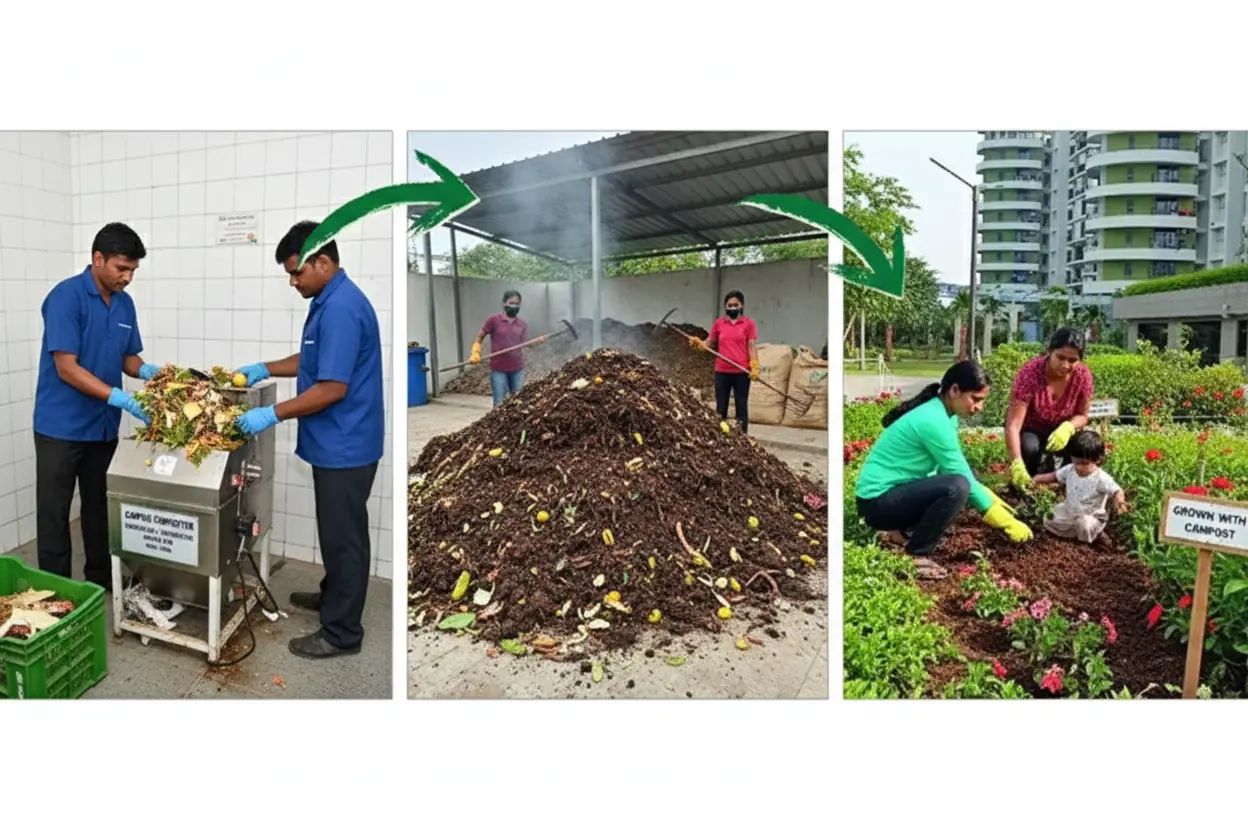
Residents segregate organic kitchen waste, vegetable peels and food scraps at home and drop it as wet waste.
-
Housekeeping staff collect only segregated wet waste and feed it into the waste composting machine, supporting Decentralized Waste Management Systems.
-
The shredder cuts the material; the system mixes it with dry bulking agents if needed.
-
Inside the chamber, controlled heat, aeration and microbes break down waste into semi mature compost within 24 48 hours in many systems.
-
The machine reduces volume by up to 70 90%, leaving stabilised compost that is cured further in crates or curing bins.
-
Finally, ready compost is used for gardens, landscaping or shared with residents as organic manure.
Key Benefits of Composting Machine for Housing Societies
A composting machine for housing societies delivers multiple short and long term gains that go far beyond just handling garbage.
-
Daily on site treatment of organic waste, reducing dependence on municipal pickups.
-
Cleaner premises and better hygiene with fewer overflowing bins.
-
Compliance with India’s Solid Waste Management Rules and local circulars.
-
Lower greenhouse gas emissions compared to sending wet waste to landfills.
-
Free, high quality compost for society gardens, rooftop farms and community landscaping.
-
Scope to sell surplus compost locally and create a small revenue stream.
Technologies and Innovations in Composting Machine for Housing Societies
|
Technology / Feature |
How It Helps Housing Societies |
Typical Use Case |
|
Fully automatic composting machine for residential societies |
Automates shredding, mixing, heating and aeration for fast, low touch operation. |
Large societies want 24 48 hour composting with minimal staff. |
|
Semi automatic composting machine for housing society |
Requires some manual loading and turning but lowers upfront composting machine price. |
Mid sized complexes balancing budget and performance. |
|
On site composting machine for housing societies (OWC) |
Decentralised system promoted by many municipal bodies for bulk wet waste. |
Societies above mandated waste thresholds that must compost at source. |
|
Electric composting machine for home and societies |
Uses heaters and sensors to speed up decomposition and control odour. |
Premium home composting machine units and society level machines. |
|
Compact organic waste composter for housing societies |
Space saving, plug and play units that fit tight urban basements or corners. |
Community composting machine for housing complexes with limited area. |
|
IoT enabled monitoring and remote diagnostics |
Tracks temperature, moisture, run time and alerts for maintenance. |
Societies want data driven oversight and lower downtime. |
|
In vessel composting with odour control |
Closed chamber design with scrubbers minimises smell and pests. |
High rise complexes where neighbours are sensitive to odour and hygiene. |
Pros and Cons of Composting Machine Works in a Housing Society
|
Pros |
Cons |
|
Cuts wet waste volume and hauling costs. |
Needs upfront investment and regular maintenance. |
|
Produces free compost for gardens. |
Requires proper segregation and resident participation. |
|
Improves hygiene, reduces odour and pests. |
Needs dedicated space, power and trained staff. |
Why Housing Societies Need Composting Machines Today
Across Indian cities, housing societies handle rising piles of food waste every single day.
-
Urban wet waste makes up over half of municipal solid waste, and landfills are already under extreme pressure.
-
Many city regulations now make on site composting mandatory for bulk generators like large societies and townships.
-
Some municipal corporations offer property tax rebates to societies that compost and send zero wet waste to the city.
-
Residents increasingly expect ecofriendly amenities and prefer communities that manage waste responsibly.
-
A community composting machine for housing complexes supports national goals under Swachh Bharat Mission and Smart Cities Mission.
-
Adopting the best composting machine for housing societies in India also demonstrates strong community leadership and EEAT in sustainability decisions.
How Do Home and Society Composting Machines Fit Together?
A composting machine for housing society often works alongside smaller options such as composting machine for home or composting machine for home use.
-
Individual residents may use a wet waste composting machine for home or home composting machine for kitchen scraps.
-
The society level organic waste composting machine for housing societies then handles common area waste and overflow.
-
When space is tight, a compact food composting machine or waste composting machine can be used for certain wings or towers.
-
Residents living in flats can still choose an electric composting machine for home to manage part of their own organic waste.
-
Learning how to make a compost machine at home or trying basic DIY bins helps families understand segregation and what to do with compost in an apartment.
What About Composting Machine Price and ROI for Societies?
Housing society composting machine price in India depends on capacity, automation level and brand.
-
Smaller community units start lower, while large fully automatic systems can run into several lakhs.
-
Over time, societies save on monthly waste transportation, disposal charges and chemical fertiliser costs.
-
Many case studies show payback periods of roughly 18 36 months through savings and compost value.
-
Understanding food waste composting machines for home price helps residents compare personal and community investments.
Final Thoughts about Composting Machine for Housing Societies
A well chosen composting machine for housing societies turns everyday wet waste into a local resource, keeping your community cleaner, greener and more self reliant. By managing organic waste on site, housing societies can reduce landfill dependence, meet solid waste management regulations, lower disposal costs, and produce useful compost for gardens and landscaping. With the right machine capacity, technology and resident participation, composting becomes a simple, sustainable solution for modern apartment living.
Go green with Pious organic waste composting solutions built for sustainable communities.
FAQ’s
Q: How much space does an organic waste composting machine for housing societies need?
Ans: Space needs vary by capacity, but many compact organic waste composters for housing societies fit in a small room near the garbage area.
Q: Does a compost machine for housing society smell?
Ans: When operated with proper segregation, aeration and odour control, a compost machine should run with minimal smell and no nuisance to residents.
Q: Who operates a fully automatic composting machine for residential societies?
Ans: Usually housekeeping or facility staff run the system after vendor training, with simple daily routines and basic periodic checks.
Q: What can we do with the compost generated in an apartment complex?
Ans: Societies typically use compost in gardens and landscapes, share it with residents or sell surplus locally to farmers and gardeners.
