What is Decentralized Waste Management?
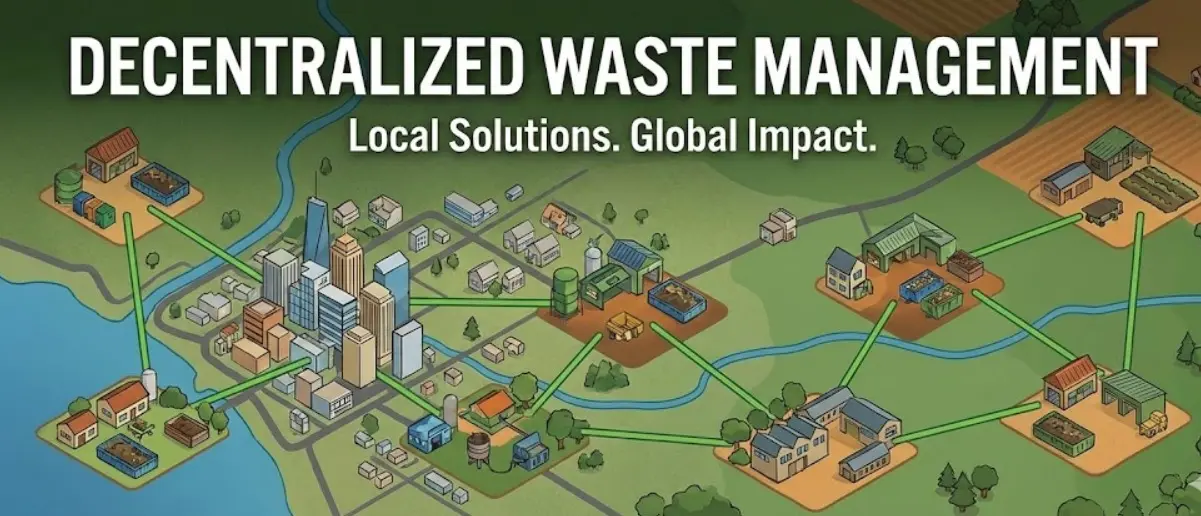
Decentralized waste management refers to a waste control system which operates at local sites to treat waste materials that are discarded at their original creation point. The system achieves its objectives by reducing transportation needs while it encourages community involvement and enables resource recovery through its network of processing centers.
Transform waste into wealth with our innovative In-Vessel Composting System—perfect for efficient and eco-friendly waste management!
Types of Waste Handled in Decentralized Systems
|
Waste Category |
Examples |
Processing Method |
|
Organic/Biodegradable Waste |
Food scraps, garden waste, agricultural residue |
Composting, anaerobic digestion |
|
Recyclable Dry Waste |
Plastic, paper, metal, glass |
Material recovery facilities (MRFs) |
|
Wet Waste |
Kitchen waste, vegetable market waste |
Vermicomposting, biogas generation |
|
Construction & Demolition Waste |
Concrete, bricks, wood |
On-site sorting and reuse |
|
E-Waste |
Electronic components, batteries |
Specialized decentralized collection centers |
|
Sanitary Waste |
Personal hygiene products |
Dedicated treatment units |
Decentralized solid waste management systems are particularly effective for handling organic and biodegradable waste, which constitutes approximately 50-60% of India's municipal solid waste.
Take control of your waste with our smart Composting Machines, designed for housing societies and beyond!
Key Components of a Decentralized Waste Management Solution
A comprehensive decentralized waste management system comprises several essential elements:
- Source Segregation Infrastructure: Color-coded bins and awareness programs encourage households to separate their waste at the moment of generation
- Door-to-Door Collection Network: Community-based waste pickers and sanitation workers carry out their duties to establish organized waste collection procedures
- Micro Composting Centers (MCC): The small-scale facilities transform wet organic waste into nutrient-rich compost materials
- Material Recovery Facilities (MRFs): The localized centers handle the process of sorting and processing and storing recyclable materials
- Decentralized Treatment Plants: The on-site facilities operate biogas generators and composting units and waste-to-energy systems
- Community Engagement Programs: The training modules together with their behavior change campaigns work to establish waste segregation practices
- Digital Monitoring Systems: The system uses IoT technology to track waste collection routes and monitor treatment efficiency.
These components work synergistically to create a robust decentralized solid waste management system that reduces dependency on centralized landfills. Want a cleaner, eco-friendly approach to Hospital Waste Management? Discover our efficient composting solutions today!
Technologies Used in Decentralized Waste Management
|
Technology |
Application |
Efficiency |
Output Products |
|
Anaerobic Digestion |
Organic waste treatment |
70-90% COD removal |
Biogas (methane), bio-fertilizer |
|
Aerobic Composting |
Biodegradable waste processing |
90-98% BOD reduction |
Organic compost, soil conditioner |
|
Vermicomposting |
Food waste decomposition |
60-70% volume reduction |
Nutrient-rich vermicompost |
|
Membrane Bioreactor (MBR) |
Wastewater treatment |
95-99% contaminant removal |
Reusable water for irrigation |
|
Waste-to-Energy Plants |
Mixed waste conversion |
15-20 MJ/kg energy output |
Electricity, compressed biogas (CBG) |
|
Pyrolysis Systems |
Plastic waste treatment |
70-85% conversion rate |
Fuel oil, char, syngas |
|
Sequential Batch Reactors |
Industrial wastewater |
85-92% nutrient removal |
Treated effluent for reuse |
What is decentralized wastewater treatment? It encompasses technologies like constructed wetlands, septic tank systems, and decentralized wastewater treatment systems (DEWATS) that treat sewage near its source without extensive sewer networks. Revolutionize your food waste disposal with our Industrial Food Waste System—sustainable, safe, and effective!
The decentralized wastewater management systems are gaining prominence in India, with cities like Delhi investing ₹31.4 billion in 27 decentralized sewage treatment plants as of 2026.
Centralized vs Decentralized Waste Management
|
Parameter |
Centralized System |
Decentralized System |
|
Location |
Single large facility far from source |
Multiple facilities near waste generation points |
|
Infrastructure Cost |
High capital investment (₹100-200 crore) |
Lower setup costs (₹5-20 crore) |
|
Transportation |
Long-distance hauling increases costs and emissions |
Minimal transport, reduced carbon footprint |
|
Processing Capacity |
500-2000 TPD (tonnes per day) |
5-50 TPD per facility |
|
Technology Complexity |
High-end automated systems |
Simple, locally manageable technologies |
|
Community Involvement |
Limited public participation |
High community engagement and ownership |
|
Maintenance |
Specialized technical expertise required |
Can be managed by trained local operators |
|
Scalability |
Difficult to expand incrementally |
Modular and easily scalable |
|
Resource Recovery |
Lower quality due to mixed waste |
Higher quality recyclables from source segregation |
|
Resilience |
Single point of failure affects entire system |
Distributed network ensures operational continuity |
The cost per capita of solid waste management using decentralized methods is ₹526 compared to ₹612 for centralized approaches, demonstrating significant economic advantages. Ready to franchise and make a real impact in the waste management industry? Learn more about our Franchise Opportunities and join the green revolution!
Benefits of Decentralized Waste Management Solutions
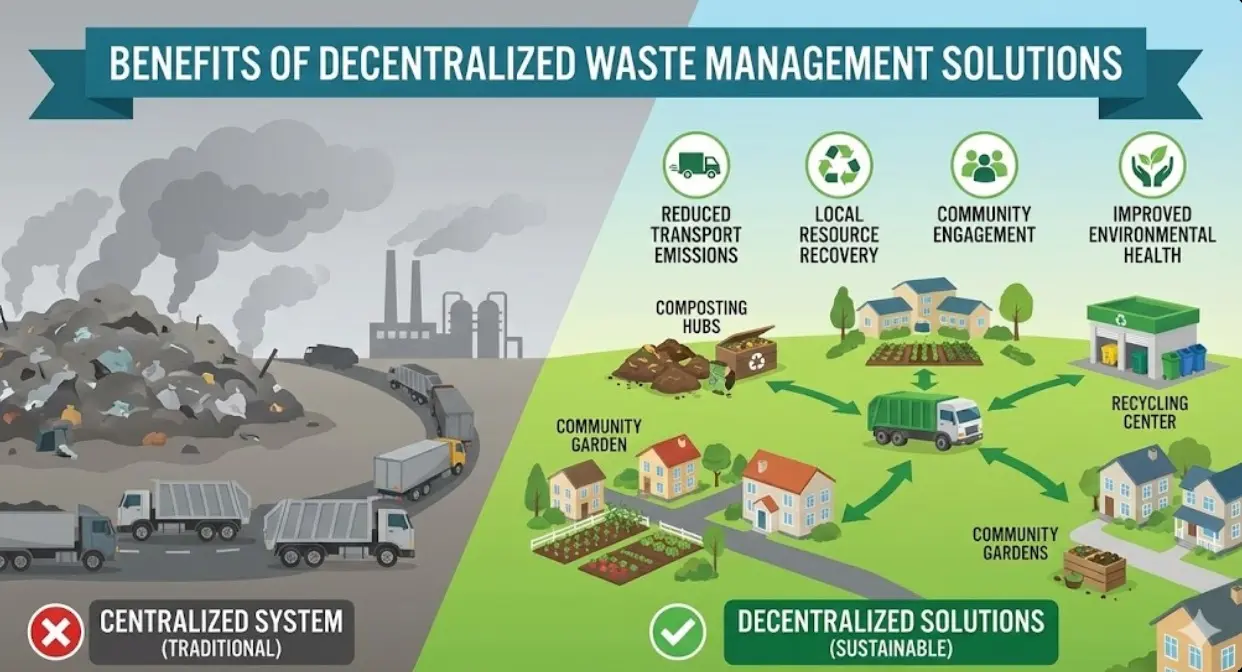
Decentralized waste management solutions offer transformative advantages for urban and rural communities:
- Treating waste locally reduces transportation costs by 30–50%.
- The process of lowering greenhouse gas emissions occurs by reducing vehicle use and capturing methane from organic waste.
- The practice of source segregation results in recyclable materials which contain 25% to 40% better quality than before, which leads to higher market value of the materials.
- The system creates green employment opportunities for waste pickers, composting operators, and facility managers.
- Decentralized waste-to-energy systems produce 17,000 kilograms of bio-CNG daily by processing 550 tonnes of waste, as demonstrated in Indore.
- The process of localized wastewater treatment allows for irrigation and non-drinking water reuse, which lessens the need for freshwater by 30% to 40%.
- The operational start time of decentralized systems requires only six to twelve months, while centralized facilities need three to five years for their start time.
Studies from Tirunelveli, Tamil Nadu demonstrate that decentralized solid waste management systems process waste more cost-effectively per capita than traditional centralized methods. Unlock eco-friendly waste management with our Solutions tailored for every need—from hospitals to housing societies!
What Role Does Circular Economy Play in Decentralized Waste Management?
The circular economy framework transforms waste from a disposal problem into a resource opportunity. The implementation of circular economy principles depends on decentralized waste management systems:
- Localized Material Loops: The method of waste processing which occurs at its original location allows for better material recovery which can be reused in local production processes.
- Waste-to-Resource Conversion: Urban agriculture receives organic waste which transforms into compost while plastic waste gets converted into building materials and fuel products.
- Extended Producer Responsibility: The collection networks which operate through decentralized systems enable manufacturers to take responsibility for managing their products after customers finish using them.
- Zero Waste Communities: The cities of Indore and Ambikapur achieve 95 to 100 percent waste processing through their decentralized circular waste management systems.
- Industrial Symbiosis: One facility produces waste which other local industries use as their primary material supply within their resource-sharing system.
- Value Chain Integration: The organized decentralized collection systems provide waste pickers from the informal sector with formal recognition which leads to improved economic stability.
The Swachh Bharat Mission promotes decentralized composting facilities and material recovery as key strategies for building circular economy infrastructure in Indian cities.
What Are the Challenges in Implementing Decentralized Waste Management?
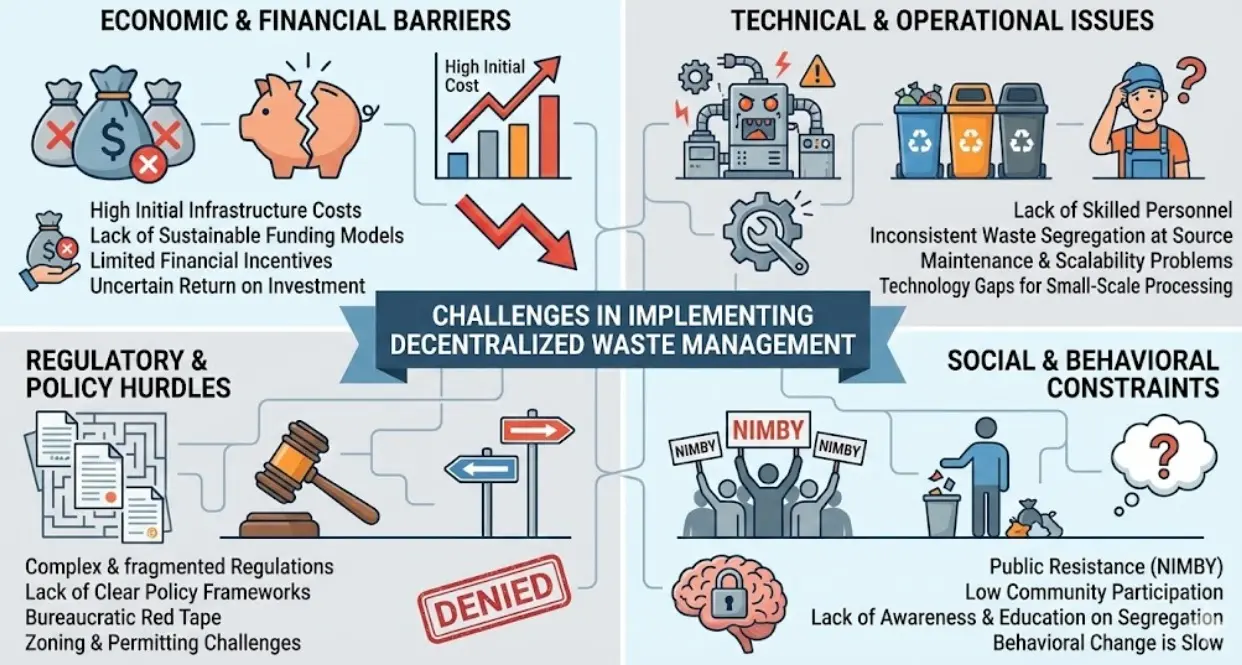
Despite numerous benefits, decentralized waste management systems face implementation barriers:
- The process of creating multiple small-scale facilities needs organized funding because their operational expenses exceed those of central systems.
- Rural and semi-urban areas face difficulties because they lack skilled workers who can operate and maintain decentralized waste treatment systems.
- The waste processing system efficiency suffers because only 30 to 40 % of Indian households follow the waste segregation practice.
- Urban areas find it difficult to provide sufficient space for composting centers and material recovery facilities which serve local neighborhoods.
- National waste management regulations face challenges due to uneven compliance across states.
- Decentralized facilities need proper monitoring because they will create substandard compost and allow contamination of recyclables without it.
- The waste industry needs to establish formalized waste picker systems that require social acceptance and administrative frameworks to operate within decentralized systems.
- The decentralized system needs design flexibility because waste composition and quantity change throughout the different seasons.
- The operation of decentralized models needs municipal bodies to work together with NGOs and community groups and private operators.
Government initiatives like Swachh Bharat Mission 2.0 (2021-2026) allocate ₹1.41 lakh crore for addressing these challenges through infrastructure development and capacity building.
How Can Communities Adopt Decentralized Waste Management?
- Successful implementation of decentralized waste management requires strategic planning and community mobilization.
- The proven cradle-to-grave model from Mysuru demonstrates effective practices.
- Organizations and residential societies can establish on-site composting facilities using technologies like CHUGG food waste treatment plants that process 50-200 kg daily.
- The Gobardhan scheme helps rural communities build biogas plants which produce cooking fuel and electricity from cattle dung and agricultural waste.
- Urban local bodies must establish micro-level waste management systems which require all neighborhoods to have material recovery facilities and composting centers.
- The success of Pune demonstrates how the city has integrated self-help groups for women into its waste collection system, which has created jobs and improved waste separation efficiency.
- The implementation of decentralized waste management systems is being accelerated through the use of IoT-powered smart bins and GPS-enabled collection trucks which deliver instant operational data.
- Mobile applications establish direct links between waste generators and collection services which promote transparent customer tracking systems.
- The Ministry of Housing and Urban Affairs offers technical support and funding solutions to implement decentralized solid waste management systems through its various programs.
- Local communities can obtain funding through viability gap funding together with CSR investments and public-private partnership models to build their waste management facilities.
What is the Future of Decentralized Waste Management in India?
- The waste management system in India is now in the process of undergoing changes.
- The daily per capita waste generation rate will reach 0.7 kilograms by 2025 and total annual waste will exceed 165 million tonnes by 2030.
- The decentralized approach has now gained recognition as the fundamental requirement for handling this growing demand.
- The state governments require businesses to practice source segregation while they support their establishment of local waste processing centers.
- The introduction of blockchain technology for waste tracking together with AI sorting systems and automatic composting machines is streamlining waste management operations at small waste management sites.
- Climate change mitigation strategies support decentralized methods which decrease transportation emissions while trapping methane produced from organic waste.
- The carbon credit system creates extra income opportunities for local biogas and composting initiatives.
- The National Urban Livelihoods Mission together with the Swachh Bharat Mission establishes pathways that enable informal waste workers to join decentralized systems while providing them with respectable work opportunities and protection benefits.
- Cities are now investing in decentralized sewage treatment systems which use compact sewage treatment plants to serve 50 to 500 households instead of building traditional sewer networks.
- The modular systems function effectively in both periurban zones and small urban centers.
Final Thoughts About Decentralized Waste Management
Decentralized waste management establishes a new sustainable waste management system which operates through community control of resource management. The systems achieve several benefits by processing waste at local sites which helps to decrease operational expenses and creates job opportunities and supports circular economy systems while solving India's waste management issues.
Frequently Asked Questions Related to the Decentralized Waste Management
Q1. What is the meaning of decentralized waste management?
Decentralized waste management meaning refers to waste treatment and processing which takes place at the waste generation site through community-based facilities instead of sending waste to remote centralized treatment plants.
Q2. How does decentralized wastewater treatment work?
Decentralized wastewater treatment uses on-site or cluster systems like septic tanks, constructed wetlands, and membrane bioreactors to treat sewage without the need for extensive sewer systems, which allows for water recycling.
Q3. What are the main benefits of decentralized solid waste management systems?
Key advantages include 30-50% cost reduction, 60-70% landfill diversion, local employment generation, improved recyclable quality, and faster implementation compared to centralized approaches.
Q4. Which technologies are used in decentralized organic waste management?
Common technologies include aerobic composting, vermicomposting, anaerobic digestion for biogas production, and waste-to-energy plants that convert organic matter into compost and renewable energy.
Q5. What challenges do decentralized waste management solutions face?
Primary challenges include securing initial funding, training operators, ensuring consistent waste segregation, allocating land in dense urban areas, and coordinating between multiple stakeholders.
