What is Composting and Why It Matters
Composting transforms organic waste into nutrient-rich soil amendment through natural decomposition. This process diverts waste from landfills, reduces greenhouse gas emissions by over 50%, and supports sustainable agriculture.
Modern composting methods offer efficient solutions for managing municipal, commercial, and industrial organic waste streams. Discover innovative solutions for sustainable waste management at Pious Earth. Let’s make the world greener together!
Understanding In-Vessel Composting Systems
Existing practices improved organic waste management, with in-vessel composting systems such as the drum, tunnel, or silo systems. In contrast to the vast areas needed for traditional windrow systems, in-vessel composting plants require little space and give high decomposition rates.
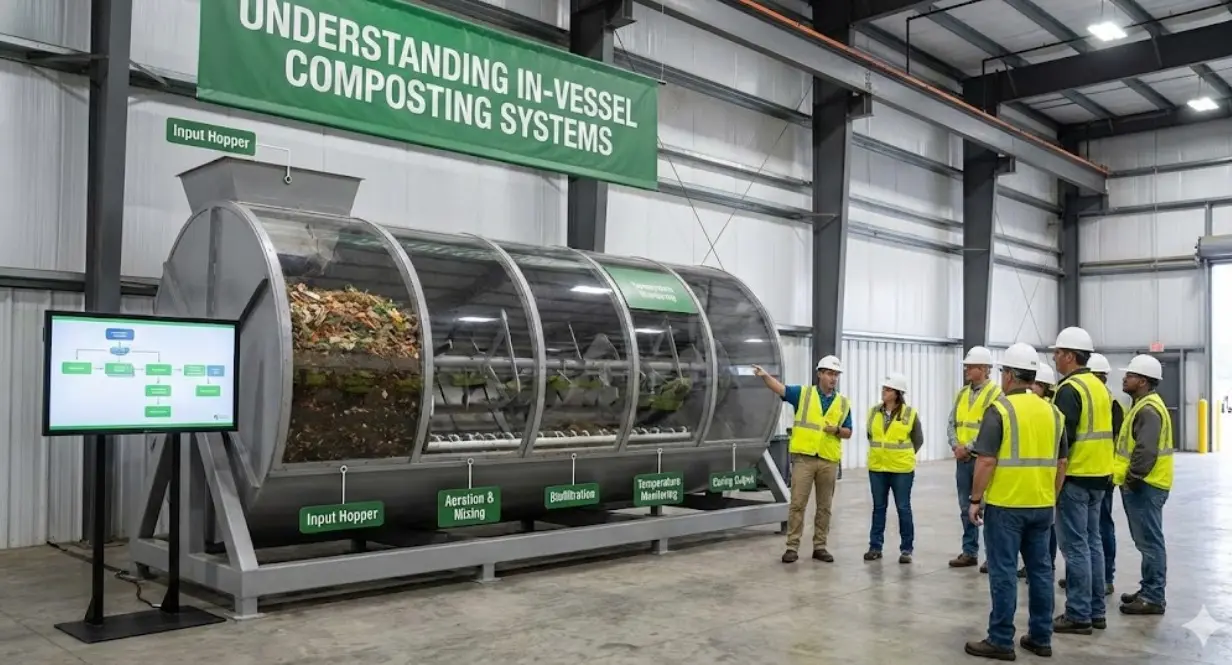
One distinctive feature of the IVC system is its maintenance of very fine control over the compost pile temperature and optimum moisture content of air in the composting system. The extended grade composting is conducted within a purposely insulated system, preventing any temperature, odor, or off-gassed odors from escaping from the reactor. lua No toxic emissions or contaminated leaches were allowed to pass the biological reactor. The controlled environment composting routes often give final products from 2-6weeks vis-a-vis months with conventional methods. Unlock the potential of decentralized solid waste management to transform local waste into eco-friendly resources.
Key Features of In-Vessel Systems
Closed vessel composting technology offers distinct advantages through specialized design:
- An enclosed building system achieves complete odor control while stopping pests from entering the building.
- The system automatically conducts temperature and oxygen and moisture level measurements.
- The composting process uses forced aeration to create conditions which enable maximum microbial growth.
- The system requires only a small area which makes it ideal for use in urban areas with limited space.
- Weatherproof composting unit enabling year-round operation
- Integrated biofilter composting system treating exhaust gases
- Rapid processing completing decomposition in 14-21 days
How In-Vessel Composting Works
The Composting Process - Step by Step
Containerized composting systems follow a systematic workflow:
-
Material Reception: Organic waste arrives at enclosed facilities where contaminants are removed
-
Shredding and Mixing: Materials are processed to uniform size and blended with bulking agents
-
Vessel Loading: Prepared feedstock enters the composting reactor through automated systems
-
Active Composting: Bioreactor composting systems maintain 60-70°C temperatures for pathogen destruction
-
Aeration Control: In-vessel aerobic composting delivers oxygen through perforated pipes or mechanical mixing
-
Monitoring: Sensors continuously track conditions inside the controlled composting vessel
-
Discharge: Processed material exits for maturation in secondary systems
Stages of Composting Inside the Vessel
The in-vessel organic waste processor manages distinct composting phases:
-
Stage 1 - Sanitization (7-21 days): First barrier maintains 60-70°C destroying pathogens and weed seeds
-
Stage 2 - Stabilization (7-21 days): Second barrier continues decomposition with controlled temperature and oxygen
-
Stage 3 - Maturation (10-14 weeks): Material cures in open windrows or enclosed areas achieving stabilization
-
Final Processing: Screening produces various compost grades for different applications
Explore our solutions that bring sustainable waste management practices to your community, industry, or home.
Types of In-Vessel Composting Systems
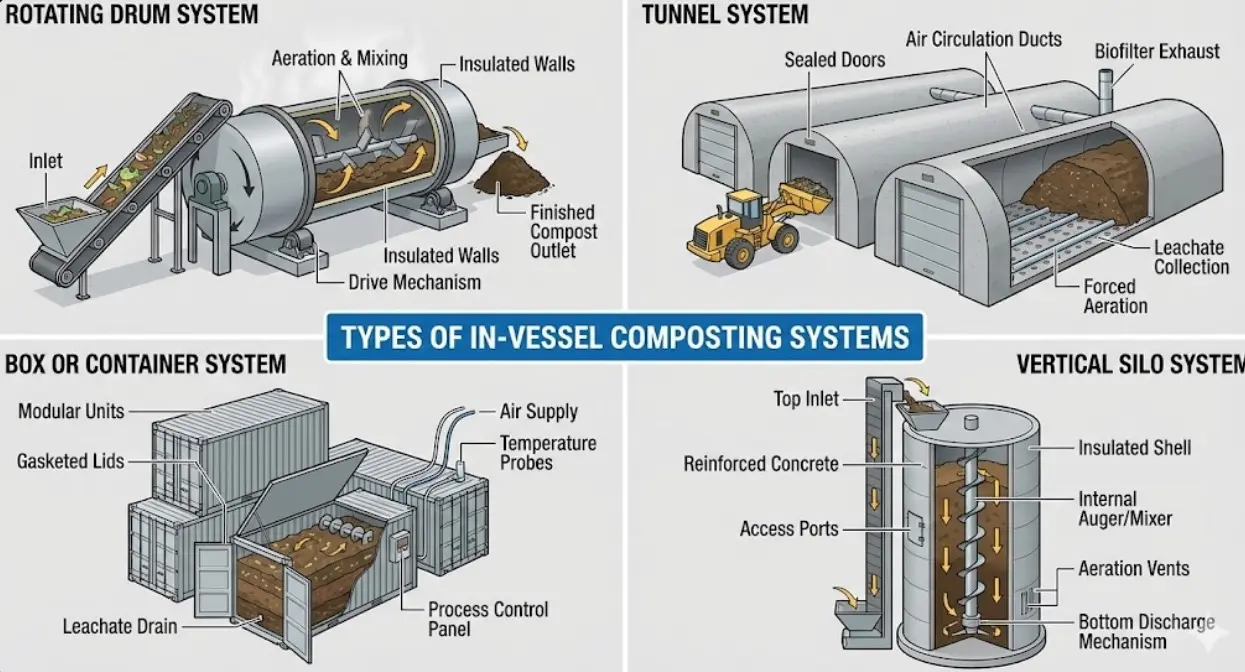
Commercial composting equipment encompasses diverse technologies:
-
Rotary Drum Composting System: Rotating drum composter units ranging 10-50 meters length with 3-4 meter diameter
-
Drum Composting Technology: Cylindrical vessels rotate 4-10 times hourly with retention periods of 3-7 days
-
Tunnel Composting System: Large-scale composting tunnel technology in concrete channels with mechanical agitation
-
Silo Composting System: Vertical tower composting reactor structures for gravity-fed processing
-
Vertical Composting System: Space-efficient designs stacking vessels or chambers
-
Modular Composting System: Stackable units allowing capacity expansion
-
Plug Flow Composting System: Continuous material movement from input to discharge end
-
Agitated Bed Reactor Composting: Open-top concrete channels with automated turners on rails
-
Batch Composting System: Fixed loads processed completely before new material addition
-
Continuous Flow Composting System: Ongoing material feeding with regular discharge cycles
-
Automated Composting Machine: Fully computer-controlled operations requiring minimal labor
Join the green revolution with a Pious Earth franchise and be part of a sustainable future!
Components of an In-Vessel Composting System
|
Component |
Function |
Key Features |
|
Enclosed Vessel/Container |
Primary composting chamber |
Insulated, weather-resistant, corrosion-proof construction |
|
Aeration System |
Oxygen delivery |
Perforated pipes, blowers, fans with variable speed control |
|
Mixing Mechanism |
Material homogenization |
Rotating drums, augers, paddles, or rams |
|
Temperature Sensors |
Process monitoring |
Multiple probes tracking thermal conditions |
|
Moisture Control |
Water management |
Irrigation systems, drainage, leachate collection |
|
Biofilter System |
Odor treatment |
Biological scrubbing of exhaust gases |
|
Control System |
Process automation |
Computer interface, SCADA systems, remote monitoring |
|
Loading Equipment |
Material input |
Conveyors, augers, automated feeders |
|
Discharge System |
Compost removal |
Sliding doors, conveyors, walking floors |
Feedstock Types Suitable for In-Vessel Composting
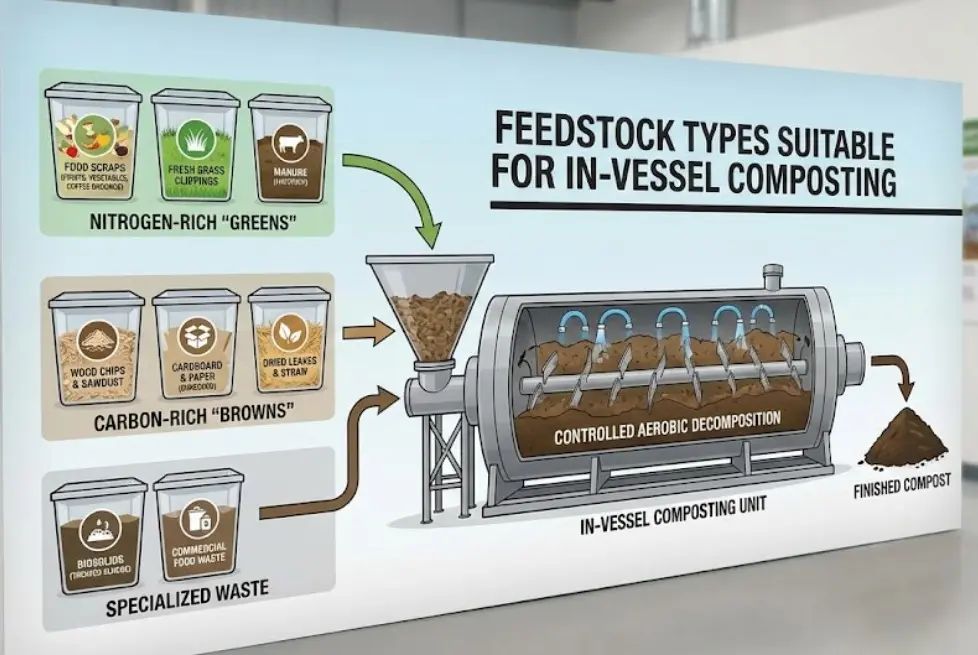
Mechanical composting systems process diverse organic materials:
-
The Food Waste Composting System processes all kitchen scraps and plate waste and all preparation residuals from homes and businesses.
-
The Food Scraps Composting Reactor accepts outdoor composting prohibited materials which include meat and dairy products and oils.
-
The Municipal Solid Waste Composting system processes organic materials which residents separate from their waste.
-
The Biosolids Composting System uses treated sewage sludge which comes from wastewater treatment facilities.
-
The Manure Composting Reactor processes all livestock waste which includes waste from poultry and cattle and swine and dairy animals.
-
The Garden and yard trimmings collection includes all grass clippings and leaves and pruning waste and brush materials.
-
Agricultural residues include all crop waste and straw and plant materials.
-
The commercial organic waste stream consists of all restaurant waste and food processing byproducts.
-
The paper products category includes shredded paper and cardboard which function as carbon-rich bulking agents.
Find out how our industrial food waste systems can help businesses reduce waste and improve sustainability.
Advantages of In-Vessel Composting and Challenges & Limitations
|
Advantages |
Challenges & Limitations |
|
Rapid Processing: Produces compost in 2-6 weeks vs. months for windrows |
High Capital Costs: Equipment investment $19,000-$180,000 depending on capacity |
|
Space Efficiency: Requires 75-90% less area than outdoor methods |
Technical Expertise: Requires trained operators and maintenance staff |
|
Odor Control: Sealed design with biofilters eliminates 95%+ odor emissions |
Limited Capacity: Smaller volume processing compared to windrow systems |
|
Year-Round Operation: Climate-controlled processing unaffected by weather |
Energy Requirements: Fans, mixers, controls require continuous electricity |
|
Pathogen Destruction: Consistent 60-70°C temperatures ensure sanitization |
Equipment Maintenance: Moving parts require regular inspection and repair |
|
Regulatory Compliance: Meets Class A compost standards and ABPR requirements |
Feedstock Sensitivity: Requires careful material balancing and preparation |
|
Minimal Labor: Automation reduces manual handling requirements |
Operational Complexity: Demands monitoring multiple parameters simultaneously |
|
Urban Compatibility: Suitable for densely populated areas with noise/odor concerns |
Scale Economics: Most cost-effective at medium-large volumes |
Transform community waste into compost with our composting machine for housing societies.
Comparing In-Vessel Composting to Other Methods
|
Feature |
In-Vessel Composting |
Windrow Composting |
Aerated Static Pile |
|
Processing Time |
2-6 weeks |
3-6 months |
3-6 months |
|
Space Requirements |
10-30 m² per unit |
2-4 acres for medium operations |
1-2 acres typical |
|
Odor Control |
Excellent with biofilters |
Poor to moderate |
Good with covers |
|
Weather Dependence |
None - fully enclosed |
High - rain/cold affects process |
Moderate with covers |
|
Initial Investment |
$19,000-$180,000 |
$5,000-$50,000 |
$10,000-$80,000 |
|
Operating Costs |
Moderate - energy/maintenance |
Low - minimal equipment |
Low-moderate |
|
Labor Requirements |
Minimal - automated |
High - frequent turning |
Moderate - monitoring |
|
Pathogen Reduction |
Reliable - controlled temps |
Variable - depends on turning |
Good with proper management |
|
Suitable Scale |
Small to large operations |
Large-scale preferred |
Medium to large |
|
Urban Feasibility |
Excellent |
Poor - needs space |
Moderate |
Costs & Economic Aspects
Financial considerations for industrial composting systems:
-
Capital Equipment: High-speed composting machines require a price range between $19,000 and $50,000 which applies to their smallest machines that can process compost at a rate between one ton and five tons every day.
-
Large Scale System: The cost to establish rapid composting systems which can process between 20 tons and 60 tons of material each day starts at $80,000 and reaches a maximum of $180,000.
-
Installation Expense: The total installation costs increase equipment expenses by 20 to 40 percent through site preparation work and building enclosure construction and utility installation.
-
Operating Cost: The primary ongoing expense for operations comes from energy expenses that support both aeration and mixing processes.
-
Maintenance Budget: The annual maintenance expenses for moving components will require maintenance budget allocation between 5 percent and 10 percent of the initial capital costs.
-
Labor Saving: The development of self-contained composting systems enables organizations to cut their staffing requirements by 60 to 80 percent when compared to traditional windrow composting methods.
-
Tipping fee Revenue: The facilities generate operational income through their waste acceptance fees which range from $30 to $100 for each ton of waste that they accept.
-
Compost Sales: Finished product sells $15-$60 per cubic yard depending on quality and market
-
Landfill Diversion Savings: Organizations save $50-$150 per ton avoiding disposal costs
-
Payback Period: On-site composting systems typically achieve ROI in 3-7 years through combined savings
-
Operational Efficiency: Decentralized composting technology reduces transportation costs 40-70% compared to centralized facilities
Ensure safe and sustainable disposal of hospital waste with our hospital waste composting equipment.
Final Thoughts About In-Vessel Systems
In-vessel composting delivers efficient organic waste transformation through controlled environments. Climate-controlled composting systems minimize space requirements.
The systems eliminate odors and produce high-quality compost within a short time period. The integrated composting facilities provide optimal solutions for urban areas and institutions and operations that value efficiency more than traditional methods.
FAQs Related to In-Vessel Systems
1. How long does in-vessel composting take?
In-vessel aerobic composting completes active processing in 2-6 weeks, significantly faster than windrow methods requiring 3-6 months.
2. What temperature kills pathogens in composting?
Enclosed vessel composting maintains 60-70°C (140-158°F) for minimum 3-15 days ensuring pathogen destruction and meeting regulatory standards.
3. Can meat and dairy be composted in-vessel systems?
Yes, food waste digester machines handle meat, dairy, and oils that outdoor composting cannot process due to controlled high temperatures.
4. What is the difference between batch and continuous composting?
Batch composting systems process fixed loads completely before adding new material, while continuous flow composting systems accept ongoing inputs with regular discharge.
5. How much does an in-vessel composter cost?
Portable composting systems start at $19,000 for small units, while commercial composting equipment processing 20-60 tons daily costs $80,000-$180,000.
