What Is Wet Waste and On-Site Wet Waste Processing?
Wet waste refers to biodegradable organic waste such as food scraps, vegetable peels, and kitchen leftovers that break down naturally over time. Instead of sending this waste to landfills, on-site wet waste processing focuses on treating it right where it is generated. Using methods like composting or bio-methanation, the organic waste is converted into useful outputs such as compost or biogas. This approach reduces waste transportation, minimizes landfill burden, and supports cleaner, more sustainable waste management practices.
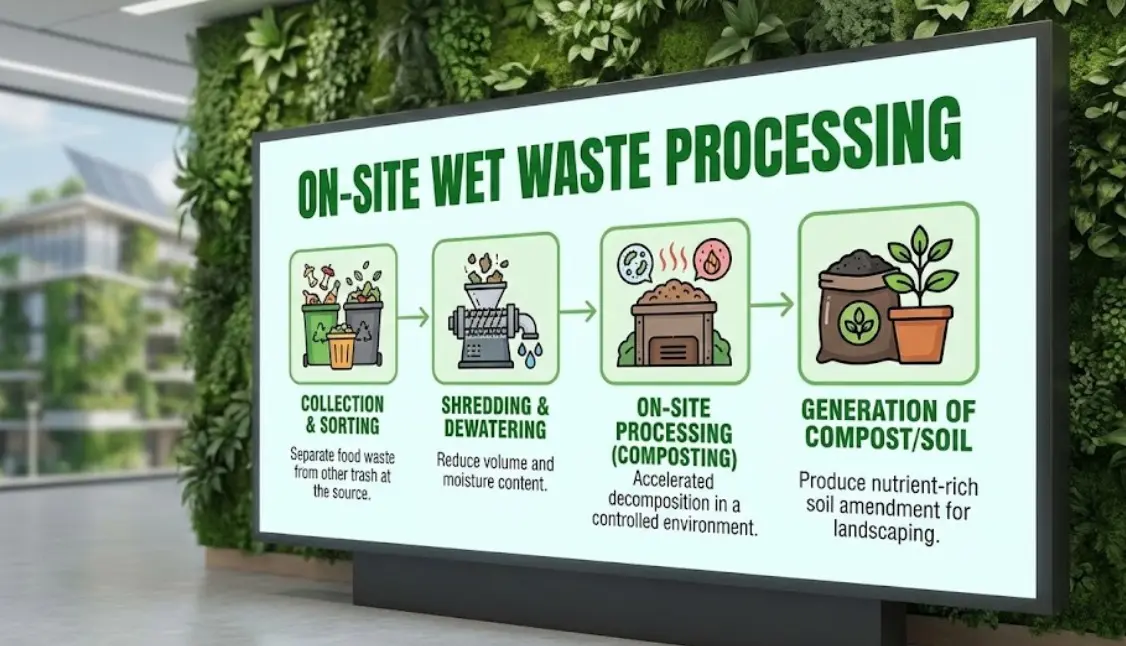
Difference Between Wet Waste Processing and Dry Waste Management
|
Aspect |
Wet Waste Processing |
Dry Waste Management |
|
Type of waste |
Biodegradable organic waste such as food, garden and canteen waste |
Non-biodegradable waste like plastic, metal, glass and paper |
|
Processing method |
Composting, bio-methanation and other biological treatments |
Segregation, recycling and material recovery |
|
End output |
Compost, biogas or soil conditioner |
Reusable or recyclable materials |
|
Environmental impact |
Reduces organic waste going to landfills |
Conserves resources through recycling |
|
Effect of mixing waste |
Mixing with dry waste contaminates recyclables |
Mixing with wet waste lowers recycling efficiency |
|
Overall efficiency |
Works best with proper source segregation |
Depends on clean, dry and segregated materials |
Why On-Site Wet Waste Processing Is Important Today
The processing of wet waste at the site decreases landfill waste while it manages odors and decreases greenhouse gas emissions and assists large waste producers with their municipal solid waste regulations.
Key Principles of On-Site Wet Waste Processing
Source segregation of wet waste and dry waste in separate bins.
-
Processing wet waste within premises using suitable technology like in situ wet waste processing.
-
Ensuring hygienic handling, odour control and vector control in all operational areas.
-
Regular monitoring of moisture, carbon–nitrogen balance and retention time for stable compost.
-
Compliance with local Solid Waste Management Rules and environmental norms.
On-Site Wet Waste Processing Methods
-
In vessel composting system for faster, enclosed, and odour-controlled on-site wet waste composting.
-
In situ wet waste processing using aerobic bins, pits, or modular Decentralized Waste Management Systems.
-
On-site organic waste processing through bio-methanation plants that generate biogas and slurry.
-
Semi-automatic and fully automatic wet waste processing machine or composting machine for housing societies and tech parks.
-
On-site municipal wet waste processing with micro-composting centres for bulk wet waste generator on-site processing.
What are the benefits of segregating dry and wet waste?
-
The system enhances recycling operations through its ability to maintain complete dry waste materials in a state of cleanliness which prevents any form of contamination.
-
The system improves composting operations for wet waste material at the location while it decreases the amount of waste sent to the landfill.
-
The system reduces greenhouse gas emissions from dumpsites while it decreases the formation of leachate.
-
Reduces operational costs for Waste Management Solutions and municipal systems.
-
Supports circular economy goals and responsible Decentralized Waste Management Systems.
Step-by-Step Process Flow for On-Site Wet Waste Management
Identify what is wet waste in your premises (kitchen, canteen waste, garden trimmings, plate scrapings).
- Set up colour-coded bins to separate wet waste and dry waste at every generation point.
- Train staff and residents on onsite wet waste processing practices and daily segregation.
- Measure daily quantities to size the wet waste processing plant or in the vessel composting system correctly.
- Choose technology: composting machine for housing societies, bio-methanation, or modular on-site wet waste processing machine.
- Install in situ wet waste processing infrastructure with proper drainage, ventilation, and power.
- Shred or pre-process canteen waste and food waste to uniform size for efficient wet waste processing.
- Load material into the selected system (on-site organic waste processing reactors or composting units) with bulking agents.
- Monitor temperature, moisture and turning schedule to maintain aerobic conditions and avoid odour.
- Cure the compost, sieve it, and store hygienically as manure for landscaping or sale.
- Record data to demonstrate compliance and performance of residential on-site wet waste processing and commercial on-site wet waste processing systems.
- Continuously improve operations, explore Franchise Opportunities and scale Decentralized Waste Management Systems where feasible.
Common Challenges in On-Site Wet Waste Processing and How to Overcome Them
-
Inconsistent segregation: Run regular awareness sessions, signage and audits for residents, staff and canteen teams.
-
Odour and pest issues: Maintain aeration, use carbon-rich bulking agents, and keep units covered but ventilated.
-
Space constraints in commercial on-site wet waste processing for tech parks and malls: Use compact vessel composting systems or automatic machines.
-
Operational downtime of wet waste processing machine: Plan preventive maintenance and operator training with service partners.
-
Regulatory compliance and documentation for on-site municipal wet waste processing: Follow local guidelines and maintain logs of quantities and outputs.
-
Scaling bulk wet waste generator on-site processing across multiple locations: Standardize Waste Management Solutions and processes for Pious institutional on-site wet waste processing networks.
How on-site wet waste processing connects to different segments
On-site wet waste processing models can be customized for different property types and sectors
-
Residential areas which include apartments and gated communities use compact composting machines and aerobic bins for their wet waste processing needs.
-
Commercial establishments which include hotels, malls and tech parks use semi-automatic systems and fully automatic systems for their wet waste management operations.
-
Institutional on-site waste management in campuses, hospitals and schools uses organic waste composting to create materials for landscaping purposes.
-
The on-site waste processing system at tech parks and IT campuses allows for the recycling of biogas and treated water resources.
-
Industrial food waste management systems handle large volumes from factories, food processing units and big canteens
-
Factory canteen waste management uses heavy-duty on-site biodegradable waste processing for mixed food and kitchen waste
-
Hospital waste composting equipment treats only segregated kitchen and garden waste in enclosed, hygienic systems
Why is composting a useful way of processing wet waste?
-
Composting converts wet waste into nutrient-rich manure that improves soil health and plant growth.
-
It avoids methane emissions from landfills and supports climate goals for cities and bulk generators.
-
On-site organic waste composting cuts transport cost, tipping fee and dependency on distant wet waste processing plant facilities.
Conclusion: Moving Towards Zero-Waste Premises
On-site wet waste processing is now a practical, proven path towards zero-waste premises for residential, commercial and institutional properties. By investing in suitable wet waste processing machines, training people on segregation, and integrating on-site organic waste processing into daily operations, bulk generators can cut costs, protect the environment and meet all compliance norms with confidence.
Frequently Asked Questions for On-Site Wet Waste Processing
Q: What is wet waste in buildings?
Wet waste is biodegradable organic waste like kitchen, canteen waste and garden trimmings that decomposes naturally.
Q: How does on-site wet waste processing work?
On-site wet waste processing treats segregated wet waste within premises using composting, bio-methanation or similar systems to produce compost or energy.
Q: Do I still need external wet waste processing plant services?
With efficient on-site wet waste processing, most organic waste is handled in-house and only dry waste and rejects go to external facilities.
Q: Is on-site wet waste composting suitable for small societies?
Yes, small societies can use compact composting machines for housing societies or aerobic bins sized to their daily waste generation.
Q: Can on-site systems support business growth?
Yes, scalable on-site wet waste processing and Waste Management Solutions can open new Franchise Opportunities and service lines for sustainability-focused businesses.
