Introduction to Solid Waste Management Rules 2026
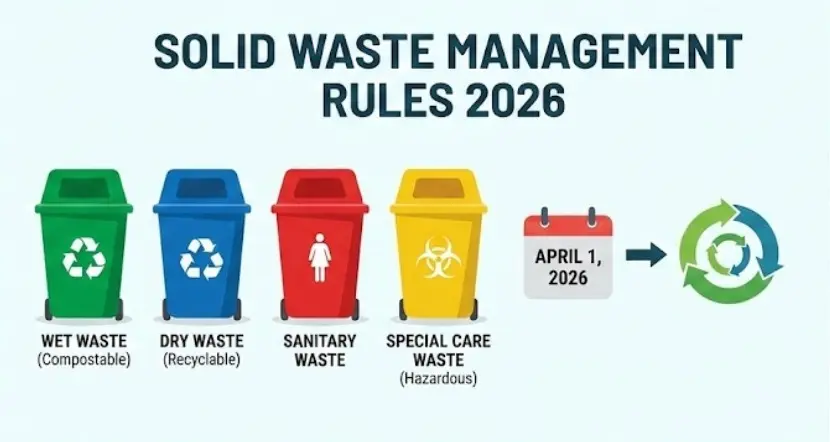
The Solid Waste Management Rules 2026 proposes four stream segregation, strict punishment, and digitalization to effectively enhance waste collection, treatment, and reduction in landfills in both urban and rural India.
Why India Needed New Solid Waste Management Rules
-
The growing urban populace and per capita waste generated by people violate the Solid Waste Management Rules of 2016.
-
Large amounts of mixed wastes arriving at landfills caused fires, leachate problems, and public health issues.
-
Deficiencies in enforcement mechanisms, sanctions, and monitoring led to a failure to observe existing waste management regulations.
-
The global focus on developing the circular economy meant that there were stronger regulations on resources and dependence on landfill.
Scale of the Solid Waste Challenge in Urban and Rural India
-
India generates about 1.85 lakh tonnes of municipal solid waste per day, much of which is still landfilled or unmanaged.
-
It is reported that most of the generated waste is collected by urban local bodies, but a lot of the total waste is processed scientifically, for instance, in Delhi and Bengaluru, due to inadequate processing capacity.
-
Current volume increases in rural and peri‑urban areas are not supported by any reasonable collection, segregation, or processing systems.
-
Waste dumping at un-designated sites, the burning of mixed waste, and plastic leakages are polluting air and soil, and water bodies in general.
LIMITATIONS OF THE SOLID WASTE MANAGEMENT RULES 2016
-
The Solid Waste Management Rules 2016 extended its scope beyond urban areas, but it lacks adequate enforcement strength.
-
Limited financial disincentives for sending unsegregated waste to landfills hindered the formation of segregation at source practice.
-
Digital tracking and online reporting of waste flows were not fully institutionalised under SWM Rules 2016.
-
Responsibilities for Bulk Waste Generators were less stringent, slowing decentralised Waste Management Solutions.
Global and National Push Towards a Circular Economy
-
Global climate and resource policies now prioritise circular economy, recycling, and reduced material footprints.
-
India’s new solid waste management rules 2026 India integrates circular economy and Extended Producer Responsibility.
-
Four‑stream segregation rules 2026 improve material recovery, high‑quality recyclables, and compostable fractions.
-
Refuse derived fuel RDF mandate in SWM Rules 2026 promotes recovery of calorific value from non‑recyclable waste.
-
Better integration of informal recyclers supports inclusive, low‑carbon growth aligned with circular economy goals.
Choosing the Right BWG Compliance Measures
-
Map total daily waste generation, share of wet, dry, sanitary, and special care waste to design on‑site systems.
-
For wet waste, evaluate In vessel composting system, bio‑methanation, or Decentralized Waste Management Systems suited to site space.
-
Use a Pious approach to source segregation, training staff, residents, and vendors to follow four‑stream norms.
-
Consider Industrial Food Waste Management Systems if operating large canteens, hotels, or institutional kitchens on campus.
-
Where on‑site processing is not feasible, obtain Extended Bulk Waste Generator Responsibility EBWGR certificate as per guidelines.
-
Integrate reliable vendors for collection, Material Recovery Facilities, and authorised recyclers in the compliance plan.
Key Features of SWM Rules 2026
-
Mandatory four stream segregation of solid waste at source into wet, dry, sanitary, and special care waste for all generators.
-
Clear bulk waste generators responsibilities under SWM Rules 2026 including on‑site wet waste processing and EBWGR.
-
Environmental compensation under SWM Rules 2026 based on Polluter Pays principle for non‑compliance.
-
Centralized online portal for registration, authorisation, data reporting, and digital audits of facilities.
-
Restriction on landfills as per SWM Rules 2026 allowing only non-recyclable, non-energy recoverable, and inert waste types and imposing higher fees for use
-
Waste bombing and bioremediation: Legacy regulations to 2026, which include mapping, deadlines, and quarterly reporting.
Roles and Responsibilities Under SWM Rules 2026
-
The SWM Rules 2026 list duties of urban local bodies as follows: door-to-door collection, segregation, transportation, and connectivity to MRFs.
-
Sanitation departments serving rural regions need to concentrate on peri-urban and rural regions.
-
Bulk Waste Generators must safely process their on-site wet waste, hand over their dry waste to authorized MRFs, and safely manage their sanitary and special care waste.
-
The Central Pollution Control Board lays guidelines, runs the portal, and standardises buffer zones as well as monitoring.
Technology‑Driven and Online Monitoring Provisions
-
Centralised Online Portal tracks waste generation, collection, transport, processing, disposal, and legacy waste remediation.
-
Registration and authorisation for processing facilities are completed online, reducing manual paperwork.
-
Facilities submit periodic performance and audit reports through the portal for transparent monitoring.
-
GIS mapping of dumpsites, landfills, and facilities supports planning and compliance checks.
-
Data analytics can guide investment in Waste Management Solutions, Decentralized Waste Management Systems, and infrastructure upgrades.
Comparison: SWM Rules 2016 vs SWM Rules 2026
|
Aspect |
Solid Waste Management Rules 2016 |
Solid Waste Management Rules 2026 |
|
Segregation |
Basic source segregation encouraged |
Mandatory four‑stream segregation rules 2026 |
|
Monitoring |
Limited digital tracking |
Centralised online portal and audits |
|
BWG Duties |
Broad BWG obligations |
Stricter EBWGR and on‑site processing |
|
Landfills |
General landfill controls |
Strong landfill restrictions and higher fees |
|
Legacy Waste |
Less explicit focus |
Time bound biomining and bioremediation rules 2026 |
Implementation Challenges and Concerns
The implementation of the 2026 rules set under the SWM may be subject to loopholes in terms of finance, local government, behavioral issues, and the inclusion of the informal workforce without disrupting processes in recyclable activities.
Infrastructure and Capacity Gaps at Local Body Level
-
Many local bodies lack adequate MRFs, composting plants, transfer stations, and compliant landfills.
-
Limited budgets constrain investments in In vessel composting systems and bio‑methanation plants.
-
Shortage of trained sanitation staff, engineers, and environmental planners slows project execution.
-
Smaller towns struggle to access technology suppliers, service providers, and standardised Waste Management Solutions.
Behavioural Change and Public Awareness Issues
-
Many households and businesses still mix waste, undermining four stream segregation of solid waste at source.
-
Inconsistent awareness campaigns reduce understanding of SWM Rules 2026 key provisions among citizens.
-
Resistance to user fees and separate storage of sanitary or special care waste persists.
-
Limited school‑level and community‑level programmes slow cultural change towards segregation and reduction.
Integration of Informal Waste Pickers and Recycling Sector
-
Informal waste pickers currently recover a large share of recyclables from streets and dumps.
-
Formalising systems without planned inclusion can displace livelihoods and reduce recycling efficiency.
-
Waste pickers should be registered by these urban local bodies and associated with them as collection and sorting agencies.
-
Social protection programs, training, and safety equipment are vital for a just transition.
Opportunities and Benefits of SWM Rules 2026
-
A higher recycling volume and recovered compost also minimize landfill pressure and pollution.
-
New decentralized systems of waste management, composting plants, and recycling plants generate green jobs.
-
Increases demand for RDF, hence growing non-recyclable preprocessed waste markets.
-
Clear norms improve investor confidence in Franchise Opportunities for local collection, MRFs, and processing hubs.
-
Strengthened duties of urban local bodies under SWM Rules 2026 enhance urban cleanliness and public health.
Way Forward: Making SWM Rules 2026 Work on the Ground
-
Prioritising city-level action plans linking budgets, infrastructures, and timelines to key elements of SWM Rules 2026.
-
Build capacity of local officials through structured training on technology, contracts, and monitoring tools.
-
Encourage BWGs to adopt Industrial Food Waste Management Systems, on‑site composting, and robust vendor partnerships.
-
Promote community engagement, school programmes, and citizen dashboards on four stream performance.
Key Provisions of Solid Waste Management (SWM) Rules, 2026
-
Solid Waste Management (SWM) Rules 2026 supersede Solid Waste Management Rules 2016 under the Environment (Protection) Act.
-
Rules effective from 1 April 2026 across urban and rural local bodies.
-
Mandatory Solid Waste Management (SWM) Rules 2026 four‑stream segregation at source for all generators.
-
Extended Bulk Waste Generator Responsibility EBWGR framework for on‑site wet waste processing or certified alternatives.
-
Environmental compensation under SWM Rules 2026 calculated on Polluter Pays principle for non‑compliance.
Penalties, Fines and Legal Risks for Solid Waste Management
|
Category |
Non‑Compliance |
Indicative Legal Risk |
|
Waste Generators |
Not segregating waste into four streams |
Environmental compensation, higher user fees as per local by‑laws |
|
Bulk Waste Generators |
Failure to process wet waste on‑site or obtain EBWGR certificate |
Environmental compensation, possible closure directions by regulators |
|
Local Bodies |
Sending unsegregated waste to landfills, poor legacy waste progress |
Higher landfill fees, adverse audit findings, directions from SPCB/CPCB |
|
Industries |
Not meeting RDF usage mandate or improper waste co‑processing |
Penalties, refusal or suspension of clearances and consents |
|
Facilities |
Operating without registration or submitting false reports |
Environmental compensation, cancellation of authorisation, legal proceedings |
SWM Rules 2026 as a Step Towards Circular and Decentralised Urban Waste Management
-
SWM Rules 2026 bring a paradigm change from being landfill-centric to a more recovery-based and circular approach to cities.
-
Segregation at source has brought improvement in the quality of compostable, recyclable, and energy-rich fractions through four-stream segregation.
-
These fractions-feed compost plants, MRFs, and RDF-based industries.
-
Bulk waste generators are encouraged to adopt on-site processing. This encourages decentralized waste management systems within campuses themselves.
-
Time-bound legacy waste biomining provides a force for cleaner streets, reduced landfills, and more resilient waste management solutions.
-
This, over time, provides opportunities for sustainable franchises and local green enterprises in collection, processing, and recycling.
Integrating Policy, Technology, and Behavioural Change toward Waste Management in India
Policy reforms will have to be in close sync with technology choices and everyday behaviour change for the SWM Rules, 2026 to deliver on their promise. City and institution-based choices would involve opting for context appropriate tools: use of a Composting Machine for Housing Societies, small bio‑methanation units, or Hospital Waste Composting Equipment to safely manage organic streams efficiently.
-
Digital portals, audits, and performance-linked penalties will help regulators track compliance effectively.
-
Long term success depends on citizens and businesses adopting segregation and reduction as daily habits.
Conclusion
The SWM Regulations, 2026 point to four‑stream segregation, on-site treatment, and digital monitoring as a method to minimize pollution, maximize recycling, and propel their policy to area-based waste management, facilitating a cleaner, healthier India.
Frequently Asked Questions on Solid Waste Management (SWM) Rules 2026
Q: What are SWM Rules 2026?
These are the amended national regulations that provide guidelines on segregation, collection, processing, and disposal of municipal solid waste (Garbage) in India, applicable from April 2026.
Q: How do the SWM Rules 2026 impact common citizens?
Citizens must segregate waste into 4 streams, pay user fees, and hand it to authorized collectors. Bulk Waste Generators (BWG) are large societies, campuses, or commercial complexes exceeding set limits of area, water use, or daily waste.
Q: What will change with the introduction of SWM Rules 2026 as opposed to SWM Rules?
The new rules include adding mandatory four-stream segregation, enhanced duties of BWG, landfill requirements, and online monitoring.
Q: Where can I access official information about the SWM Rules 2026?
You may refer to the press information bureau notification and updates on websites such as PIB or Drishti IAS for an authentic summary on the topic.
