About Zero Discharge Organic Waste System
The zero discharge organic waste system operates as an advanced waste treatment method which completely eliminates all liquid waste output. The self-contained composting system processes biodegradable materials through composting to produce compost while maintaining complete water use. The system applies contemporary technological solutions to achieve environmentally friendly methods of handling organic waste.
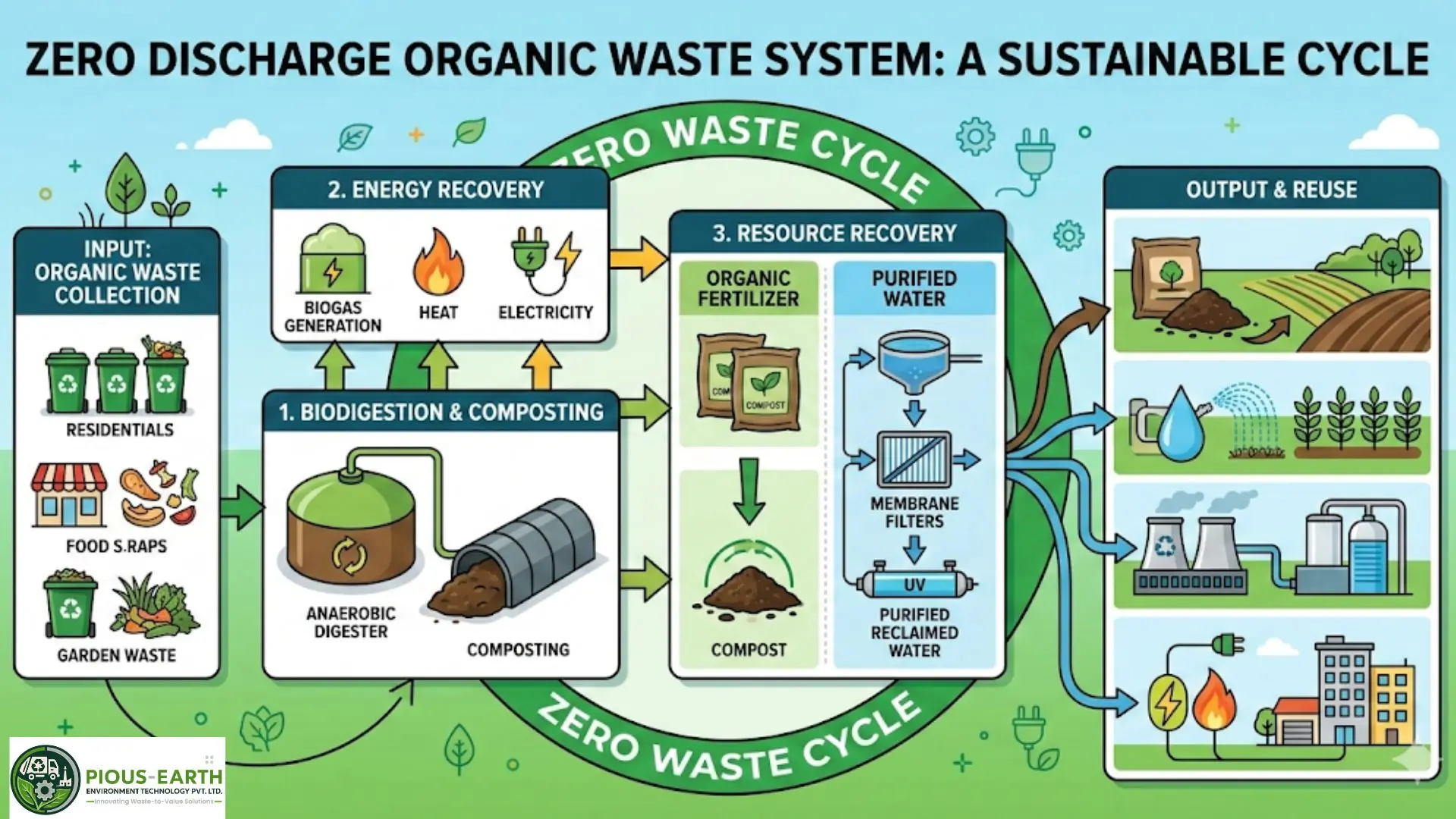
What is Zero Discharge Definition?
Zero discharge definition describes a complete wastewater treatment process which treats all liquid waste through recycling and solid waste conversion, resulting in total liquid waste elimination. The approach serves as the essential foundation that enables zero liquid discharge wastewater treatment systems to protect water resources and preserve natural environments.
Core Components of a Zero-Discharge Organic Waste System
-
Pre-treatment Unit: Waste segregation and preparation
-
Composting Chamber: Stainless steel reactor with temperature control designed to function as an in vessel composting system for controlled organic waste decomposition.
-
Mixing Mechanism: Automated shafts for uniform decomposition
-
Aeration System: Blowers ensuring oxygen supply for aerobic digestion
-
Temperature Control: Sensors maintaining optimal heat levels (35-80°C)
-
Moisture Management: Systems regulating water content
-
Safety Features: Closed-loop mechanisms and emergency stops
-
Output Collection: Compartments for finished compost extraction
How Zero-Discharge Organic Waste Systems Work
Step 1: Waste Segregation and Collection
Only biodegradable materials including food scraps, vegetable peels, and garden trimmings enter the closed loop composting system. Proper segregation ensures optimal composting efficiency.
Step 2: Pre-Processing and Size Reduction
The organic waste converter machine shreds waste into smaller particles, increasing surface area. This accelerates decomposition in the waterless organic waste composting process.
Step 3: Aerobic Digestion
The zero discharge aerobic digester introduces oxygen to enable microorganisms to break down organic matter. Temperature rises to 55-65°C, eliminating pathogens.
Step 4: Continuous Mixing and Aeration
Automated mixing ensures uniform decomposition in the contained organic waste treatment chamber. The zero discharge biodigester maintains optimal moisture levels through controlled aeration.
Step 5: Curing and Maturation
Partially decomposed material undergoes curing in the leak-proof waste composting system. This stabilization produces mature, nutrient-rich compost.
Step 6: Final Output Collection
The zero waste organic converter achieves 80-90% volume reduction. The zero leachate composting system ensures no liquid runoff contamination.
Key Benefits of Zero-Discharge Organic Waste Systems
Environmental Advantages
-
Eliminates landfill dependency and reduces methane emissions
-
Prevents groundwater contamination
-
Reduces carbon footprint through localized waste processing
-
Supports sustainable organic waste management practices
Economic Benefits
-
Lowers waste disposal and transportation costs
-
Produces valuable compost reducing fertilizer expenses
-
Minimal operating costs with automated systems
-
Creates revenue opportunities through compost sales
Operational Efficiency
-
Fast processing (24-48 hours) compared to traditional methods
-
Fully automated requiring minimal manpower, as modern systems operate as an Automatic Bio Composter managing aeration, temperature, and mixing automatically.
-
Compact footprint suitable for urban installations
-
Odorless operation with zero emission waste processing capabilities
Technologies & Innovations in Zero-Discharge Systems
|
Technology |
Application |
Key Features |
|
Aerobic Composting |
Biodegradable waste treatment plant |
Oxygen-rich, temperature control |
|
Anaerobic Digestion |
Zero effluent organic digester |
Oxygen-free, biogas generation |
|
Mechanical Vapor Compression |
Zero liquid discharge plant |
Evaporation without thermal energy |
|
Reverse Osmosis |
Zero discharge wastewater treatment system |
Membrane filtration, 80% water recovery |
|
Ultrafiltration |
Zero discharge site pre-treatment |
Removes suspended solids |
|
Crystallization |
Zero waste discharge process |
Converts brine to solids |
|
Closed System Decomposer |
Closed system waste decomposer |
Sealed environment processing |
What is Zero Liquid Discharge Process?
The zero liquid discharge process integrates multiple treatment stages. Initial zero liquid discharge wastewater treatment begins with pre-treatment removing suspended solids. The biological waste treatment system employs membrane technologies like reverse osmosis. Advanced zero discharge water systems use evaporation and crystallization for complete liquid elimination. Documentation including zero liquid discharge ppt, zero liquid discharge pdf, and zero liquid discharge flow diagram provide visual representations.
Zero Liquid Discharge Policy India
The Central Pollution Control Board (CPCB) is the regulating body for the zero liquid discharge policy in India. The state pollution control boards enforce stringent norms on industries-milling, pharmaceutical, and chemical sectors-so that they set up zero liquid discharge water systems. This policy is aligned with India's National Water Policy, 2012.
Pros and Cons of Zero Discharge Systems
|
Advantages |
Disadvantages |
|
Complete liquid waste elimination |
High initial capital investment |
|
95-99% water recovery |
Energy-intensive operations |
|
Regulatory compliance assurance |
Requires skilled personnel |
|
Resource recovery |
Complex maintenance |
|
Reduced environmental footprint |
Not economical for small operations |
Applications Across Industries
Zero-Discharge Organic Waste systems find applications in:
-
Hotels and Restaurants: Managing food waste through eco-friendly waste composting system
-
Residential Complexes: Community-level zero waste organic converter units
-
Educational Institutions: Campus composting with organic waste converter machine
-
Agricultural Facilities: Farm waste processing through closed loop composting system
-
Industrial Facilities: Large-scale zero liquid discharge plant operations
-
Municipal Corporations: City-wide Decentralized Waste Management Systems enabling local organic waste processing without long-distance transportation.
Why Does Zero Discharge Organic Waste Systems Matter?
Traditional waste disposal methods contribute significantly to environmental degradation. Landfills generate methane, a greenhouse gas 25 times more potent than carbon dioxide. The zero discharge organic waste system addresses multiple challenges simultaneously: waste reduction, water conservation, soil enrichment, and emission control. India produces over 150,000 tonnes of daily waste, with 50-60% being organic. Implementing sustainable organic waste management through self-contained composting system technology becomes critical for environmental protection.
Final Thoughts About Zero Discharge Systems
Optimal outputs in closed-system waste decomposing technologies represent the future of sustainable management for waste. These innovative technologies are redesigned into much more efficient and self-sustaining technologies capable of dealing with liquid effluents.
With regulation tightening and water crisis deepening in severity, close-system technologies for biological waste decomposing have now become an essential investment for environmental stewardship in the sustainability of operations.
Frequently Asked Questions Related to Zero Discharge Organic Waste System
Q1: How does a zero discharge organic waste system differ from traditional composting?
A zero discharge system is fully automated, processes waste within 24-48 hours, operates without generating leachate, and occupies minimal space compared to traditional methods requiring weeks and large outdoor areas.
Q2: What types of waste can be processed in a zero discharge organic waste system?
The system handles food scraps, vegetable peels, fruit waste, cooked food, small bones, garden trimmings, and other biodegradable organic materials but not plastic, metal, or non-organic substances.
Q3: Is zero liquid discharge mandatory in India for all industries?
CPCB mandates ZLD for water-stressed regions and specific industries including textiles, tanneries, distilleries, and chemical plants in states like Tamil Nadu, Gujarat, and Rajasthan.
Q4: What is the cost range for installing a zero discharge organic waste system?
Costs vary from ₹2 lakhs for small residential units (50 kg/day) to ₹50 lakhs+ for industrial-scale systems (5000+ kg/day) depending on capacity, automation level, and features.
Q5: How much compost does a zero discharge system produce from organic waste?
The system typically produces 10-20% compost by weight of input waste, achieving 80-90% volume reduction through moisture evaporation and organic matter decomposition.
